CHAPTER 05
Solar radiation on surfaces.
How much solar energy reaches a roof, a facade or a PV panel of any tilt and orientation, at one instant and over a year. The sun position comes from Chapter 02; the radiation from the weather file of Chapter 01.
Equation numbers continue from Chapter 04 (Eq. 14–22). Angle symbols are listed in the Chapter 02 nomenclature.
StartIRRADIANCE · IRRADIATION · UNITS
Quantities and symbols
Solar geometry tells where the sun is. This chapter turns the sun position into energy on a surface: the input for passive solar gain, overheating checks, daylight and PV yield.
- Irradiance G
- Power arriving per unit area, W/m². An instantaneous value, like a speed.
- Irradiation H
- Energy per unit area over a period, Wh/m² or kWh/m² (per hour, day, month or year). Irradiance summed over time, like a distance.
| Symbol | Quantity | Definition and range | Eq. |
|---|---|---|---|
| Gn · DNI | Direct normal irradiance | Beam from the solar disk, measured on a surface facing the sun. Clear sky at sea level: about 800–1,000 W/m². | 23, 27 |
| DHI | Diffuse horizontal irradiance | Radiation scattered by the sky and clouds, on a horizontal surface. 50–150 W/m² under a clear sky, the whole irradiance under overcast. | 28 |
| Gh · GHI | Global horizontal irradiance | Beam plus diffuse on a horizontal surface: DNI · sin ALT + DHI. | 23, 29 |
| TLT | Tilt | Angle between the surface and the horizontal, equal to the angle between its normal and the vertical. 0° flat roof, 90° wall, 180° soffit. | 25, 26 |
| ORI | Orientation | Azimuth of the outward normal in plan, from north, clockwise (south 180°), as in Chapter 02. | 25, 26 |
| INC | Angle of incidence | Angle between the sun ray and the surface normal. 0° at normal incidence; above 90° the sun is behind the surface. | 23, 26 |
| ρ | Ground reflectance (albedo) | Share of GHI reflected by the foreground. 0.2 is the usual default; fresh snow 0.8. | 29 |
| Gb, Gd, Gr, Gt | Irradiance on the surface | Beam, sky-diffuse, ground-reflected and total, W/m². | 27–30 |
| H | Irradiation | Energy per area over a period, kWh/m². | 31 |
LAMBERT · AIR MASS · EQ. 23–24
Cosine law
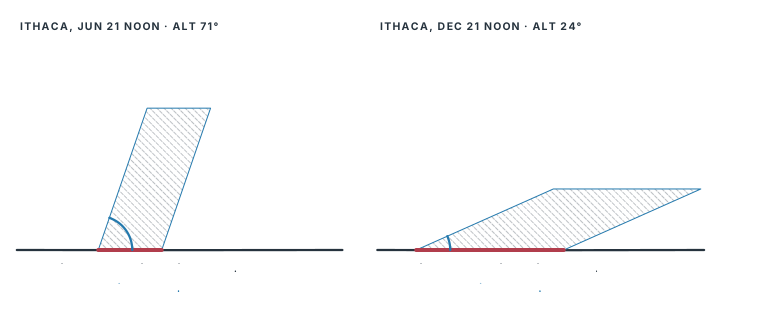
A beam of normal irradiance Gn that strikes a surface obliquely is spread over a larger area. The irradiance on the surface falls with the cosine of the angle of incidence.
A beam of cross-section 1 m² covers 1 / cos INC m² of the surface. For a horizontal surface INC = ZEN = 90° − ALT, so cos INC = sin ALT:
The low sun is weaker for a second reason: its path through the atmosphere is longer, so more of the beam is scattered and absorbed before it arrives. The path length relative to the vertical is the air mass:
- Above the atmosphere the beam carries about 1,361 W/m² (the solar constant), ±3.3 % with the earth–sun distance (Chapter 02, section 04).
- At ALT = 90° (m = 1) a clear sky passes roughly 1,000 W/m² as DNI. At ALT = 30° (m = 2) typically 800–900 W/m²; at ALT = 10° (m ≈ 5.6) much less. Eq. 24 ignores the curvature of the earth and is not used below about 10°.
- Both effects explain the seasons on the ground: in Ithaca the noon beam on a horizontal roof is 0.95 Gn on Jun 21 but 0.41 Gn on Dec 21, from a weaker Gn.
ANY TILT, ANY ORIENTATION · EQ. 25–26
Angle of incidence on a surface
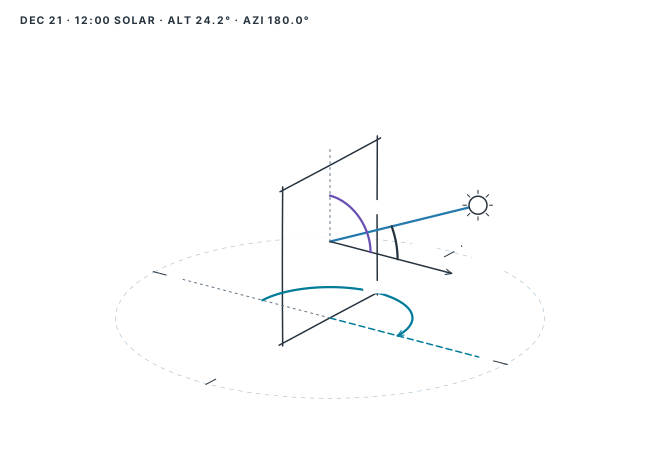
A plane surface is described by two angles: its tilt TLT and the orientation ORI of its outward normal. INC is the angle between that normal and the sun ray.
In the site coordinates of Chapter 02 (east, north, up), the outward unit normal of the surface is
and the unit vector to the sun is S = (cos ALT · sin AZI, cos ALT · cos AZI, sin ALT), the vector of Eq. 7a. The cosine of the angle between two unit vectors is their dot product:
EQ. 25–26 WITH CURRENT VALUES
- cos INC ≤ 0: the sun is behind the surface (or ALT ≤ 0). The surface receives no beam, only diffuse and reflected radiation.
- On a vertical wall the beam is strongest when the sun is low and in front of it. A south wall at 42° N gets its highest noon irradiance in winter; an east or west wall in summer, early or late in the day.
- A surface facing the equator with TLT = |LAT| has its normal parallel to the equatorial plane: at the equinoxes (DEC = 0°) the noon sun strikes it at INC = 0°.
Eq. 26 contains Eq. 23 (TLT = 0°) and the facade relation of Chapter 04 (TLT = 90°, with HSA = AZI − ORI). Test a calculation by setting the tilt to 0° or 90° and comparing.
ISOTROPIC SKY · EQ. 27–30
Beam, sky and ground components
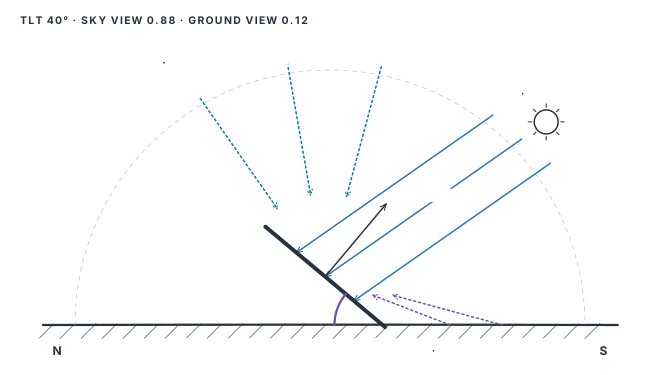
The irradiance on a tilted surface has three parts: the beam from the solar disk, diffuse radiation from the part of the sky the surface sees, and radiation reflected from the ground in front of it.
The simplest sky model treats the diffuse sky as equally bright in every direction (isotropic, Liu and Jordan). A surface tilted by TLT sees the share (1 + cos TLT)/2 of the sky dome and the share (1 − cos TLT)/2 of the ground:
EQ. 27–30 WITH CURRENT VALUES
| Foreground | ρ |
|---|---|
| Asphalt, dark roofing | 0.05–0.15 |
| Grass, soil (usual default) | 0.2 |
| Weathered concrete | 0.2–0.3 |
| Light paving, dry sand | 0.3–0.4 |
| Fresh snow | 0.7–0.9 |
- A vertical wall sees half the sky and half the ground: over snow its ground-reflected part can exceed its sky part.
- A horizontal roof sees no ground; a soffit (TLT = 180°) sees only ground.
- The isotropic model underestimates the diffuse radiation on surfaces facing the sun, because the sky is brighter around the sun and near the horizon. Simulation tools use anisotropic models (Hay–Davies, Perez) for the same three components.
WEATHER FILE · EQ. 31
From irradiance to irradiation
Annual and monthly energy on a surface is the sum of the hourly irradiance over the year. The hourly DNI and DHI come from a weather file; the sun position for each hour from Chapter 02.
- Read DNI, DHI and GHI for each hour from the EPW (fields 15, 16 and 14, Chapter 01). Each value is the energy of the hour that ends at the stated time, in Wh/m².
- Find the sun at the middle of the hour: standard time − 30 min, converted to solar time with Eq. 2 (longitude correction and EOT).
- Calculate cos INC (Eq. 26) and Gt (Eq. 27–30) for the surface.
- Sum the hours of each month and of the year (Eq. 31). With Δt = 1 h the hourly irradiance in W/m² is the irradiation in Wh/m².
ANNUAL TOTALS FOR THIS SURFACE
Bundled Ithaca Tompkins Regional Airport TMYx file (42.48° N, 76.47° W, UTC−5), the dataset of Chapter 01. Dashed line: horizontal surface.
| Surface | TLT · ORI | Jan | Jun | Year | Beam share |
|---|
- A south wall receives a similar amount every month, while a roof receives three to five times more in summer than in winter: the facade suits winter solar gain, the roof is the larger summer heat load.
- East and west walls peak in summer, when gains are least wanted. In Ithaca the west wall receives slightly more than the east wall, because afternoons are clearer than mornings in this file.
- The best fixed tilt for annual yield is close to, but below, the latitude (about 30° at 42° N here): in this cloudy climate diffuse radiation favors flatter surfaces.
Model assumptions and precision
Hourly sums use the sun at mid-hour (Eq. 2–8) and the isotropic sky (Eq. 28). The weather file is a typical year, not a forecast. No obstructions, shading devices or self-shading are included: combine with the masks of Chapter 04 for a real site. The beam of hours in which the sun rises or sets is lost when the mid-hour sun is below the horizon; for this file the horizontal total is within 2 % of the file's own GHI sum.
6 QUESTIONS · CALCULATION AND CONCEPT
Self-test
"New values" generates a new variant of a calculation. Each answer shows a worked solution.
INSTRUCTOR & AUTHOR
About the instructor

EDITABLE VECTOR FILES
Figure files
Editable SVG files of every figure. Interactive drawings save their current state with "Save SVG".
- cosine-law.svg · Fig. 1 · Cosine law
- incidence-tilted-surface.svg · interactive drawing, reference state · Angle of incidence on a tilted surface
- irradiance-components.svg · Fig. 2 · Beam, sky and ground components
SOURCES
Sources and model notes
- S. V. Szokolay, Introduction to Architectural Science, 3rd ed., Routledge, 2014. Section 1.3.1, Fig. 1.29.Cosine law, Eq. 23.
- N. Lechner, Heating, Cooling, Lighting, 4th ed., Wiley, 2015. Chapter 6, Fig. 6.5.Cosine law and air mass, Eq. 23–24.
- J. A. Duffie, W. A. Beckman, Solar Engineering of Thermal Processes, 4th ed., Wiley, 2013. Sections 1.6 (angle of incidence), 2.15–2.16 (radiation on sloped surfaces).Eq. 26–30.
- B. Y. H. Liu, R. C. Jordan, The long-term average performance of flat-plate solar-energy collectors, Solar Energy 7(2), 53–74, 1963.Isotropic sky, Eq. 28–29.
- R. Perez, P. Ineichen, R. Seals, J. Michalsky, R. Stewart, Modeling daylight availability and irradiance components from direct and global irradiance, Solar Energy 44(5), 271–289, 1990.Anisotropic sky model used by simulation tools.
- G. Kopp, J. L. Lean, A new, lower value of total solar irradiance, Geophysical Research Letters 38, L01706, 2011.Solar constant, 1,361 W/m².
- EnergyPlus weather data and EPW format ↗Hourly DNI, DHI and GHI fields.
Continue to Chapter 06: HDR photography ↗